Mining Consultant Assessment
A big thanks to Miles Moulding for his OK to reproduce his recent email below. Miles gives a very confident, convincing and detailed explanation of the original purpose of the Torwood Blue Water Pool.
AN OVERGROWN TORWOOD POOL? – NOPE!
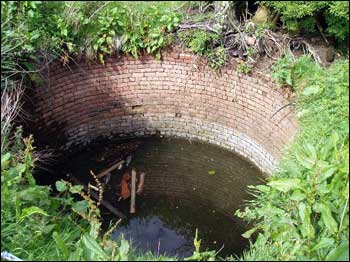
Photo by Jimbo, May 2007 (Public)
Flooded downcast shaft – the water level in this shaft is considerably higher than that in the upcast shaft so there is no longer any connection between them.
Warren moor Ironstone Mine Downcast Shaft on Kildale Moor, North York Moors (opens in new window)
My name is Miles Moulding and I work underground in disused mines (mostly as a consultant and or guide) and I’ve been a mining enthusiast for many years. I can say with certainty what your blue pool is, I recognised it instantly.
Yes, it’s a colliery airshaft. It’s a special dog-leg type, typically used where the shaft comes to surface well away from the main working surface site in an area that is not secured and/or remote.
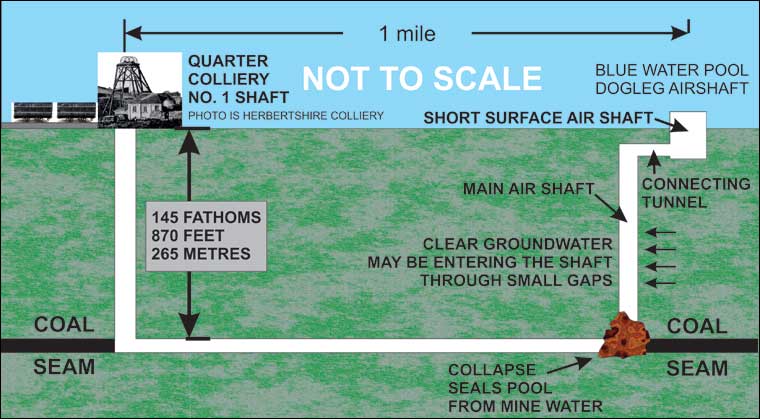
What you do is you have the main shaft (vertical, almost certainly) come up directly from the mine to extremely near the surface, typically just a few yards short. You then dig a very short shaft just to the side of the main one, from the surface to maybe 4 yards or 6 yards deep. The two get connected with a tunnel.
Why do it this way? Because the miners didn’t want rocks and rubbish thrown down the air shaft into the mine from kids messing about at the top of the shaft. That’s why it’s offset, or “dog-legged”. Quite a few here in Wales done the same way. Only used for vent shafts, not haulage shafts or similar, as the dog-leg poses no problem for air flow.
No need to do it that way on the mine site, as the site will have security. But in the woods in the middle of nowhere, a vent shaft would likely be done that way, it’s not a huge amount of extra effort and it means if people hurl things down it collects in the small shaft/chamber and doesn’t rattle down to the mine and pose a risk to men/machines below.
Railway tunnel vent shafts (or piston relief shafts) where the shaft is directly above the rails, will almost always be dog-legged in exactly the same way for the same reason. Right at the top.
The top of the shaft though should have a circular wall around it maybe 7 feet high. The bricks have probably been stolen or the wall has been vandalised and pushed into the pool. The shaft shouldn’t be open like that, you should just see what looks like a short stumpy chimney to stop people falling in (or driving cars down!). The fact that it’s a mile from the mine’s main shafts is neither here nor there, that’s nothing for a Victorian colliery. It could have over 100 miles of tunnel belonging to it, emanating out up to 30 miles from the main shafts in some cases.
I can also tell you the main shaft has suffered a significant collapse since the colliery closed, and I’ll reckon the collapse is right at the bottom in the actual seams where it joins the mine. It’s quite comprehensively blocked, because that water is separate from the mine’s main flood water. If it wasn’t, either the water level would be well down the main shaft (hence just a hole, no blue-pool), which would happen if the main shaft collar was at a lower altitude than the air shaft, or if the air shaft was the lower, then the entire mine would be draining from that air shaft. That’s not the case, as it would be pouring out constantly, loaded with orange ochre and generally nasty. Yes the shaft has flooded, as it would, but the flow is minimal, hence the clarity. It is now isolated from the mine, like I said, via a blockage that’s likely to be at the bottom.
So if you swim through that tunnel and those nice brick arches (typical of collieries), you should find a shaft dropping down to goodness knows what depth, could be anything from a few hundred feet to half a mile or more to the colliery below. In the winter I expect you’ll find the water in the deeper parts strangely warm. Warm water from in the main shaft will be rising up, and the cold water from the pool surface sinking down and getting heated up by the walls of the main air shaft (which will be around 11 degrees C, even if it’s -10 on the surface. If that small pool didn’t connect to a much deeper shaft, it wouldn’t do that.
You would normally (but not always) have a thick heavy cap or lid on the ground directly above the main shaft (so a little way from the small surface shaft). The purpose of this is to provide an easy means of inspecting the main shaft. You lift the lid (built heavy enough to require a winch or hoist to stop casual trouble makers trying it) and it opens directly down to the main shaft. You can lower a man down on a trailer-mounted powered winch to inspect it, and haul him back up when he’s finished. This lid, if it has one (and it might well not), will probably be buried in undergrowth and very hard to find now.
Would be a nice weekend project to just empty it and go for a look. Just hire a small petrol pump for a weekend from your local hire shop and camp there with it, any respectable pump should empty that chamber very quickly. The water is clean. Then drop an extension ladder down and have an explore down the tunnel (but don’t fall into the main shaft at the end!). If the pumps pipe will reach you could drop the main shaft water by 20’ or so to get a picture of it.
Please disregard comments that it might have had a Cornish beam engine on the site. It had nothing of the sort, no engine or fan or anything. It’s not an escape road, it’s highly unlikely that it was ever laddered. It’s just a vent shaft. I’m very confident in my identification (I’m not guessing), I’ll be very surprised if any of the above is inaccurate. If it was in my neck of the woods I’d just push a diver in if I wanted to confirm it, but I’m sufficiently sure here I doubt I’d bother.
The top of the airshaft/chimney wouldn’t have had a beehive roof, just a round wall like a short chimney, maybe 6’ to 8’ high, acting like a safety barrier.
The 1” pipe probably isn’t a pipe but a more likely a scaffold support peg (which could be a length of scrap pipe from the colliery). In all mine shafts you find short steel pegs sticking out from the walls, left over from the shaft’s creation and brick-lining, rarely removed afterwards. Looks like it’s a bit of scrap air-line pipe to me.
The 5” pipes look only just below the ground level? perhaps they were just above ground level when the shaft was made. In truth I’m not sure of their purpose. Mind you I often abseil down shafts of all types, there are pipes and things everywhere, their purpose is obvious about half the time and the rest are a mystery!
As for whether someone tried to convert it into a swimming pool in later years – I can’t comment on that, would explain why the wall was taken down. The water will be warmer (in winter) than an isolated pool would be, but you wouldn’t catch me bathing in it. I can’t comment on whether if someone did try to use it as a pool, whether they attempted to roof it or not. I’ve never heard of anyone using the top of a flooded shaft as a swimming pool, but it’s feasible I suppose.
You say the collar is 20 feet diameter? That’s quite a generous bore, I doubt the main shaft will be that wide, probably 10 feet.
I hope this has been of use!
Miles
What’s Next?
My next job is to get some decent quality video inside the second arch and see the first few feet of the vertical shaft dropping down over 800 feet — makes me shudder to think what might have disappeared down there already.
For the time being at least, I have to say that NOBODY SHOULD SWIM in the Torwood Blue Water Pool.